
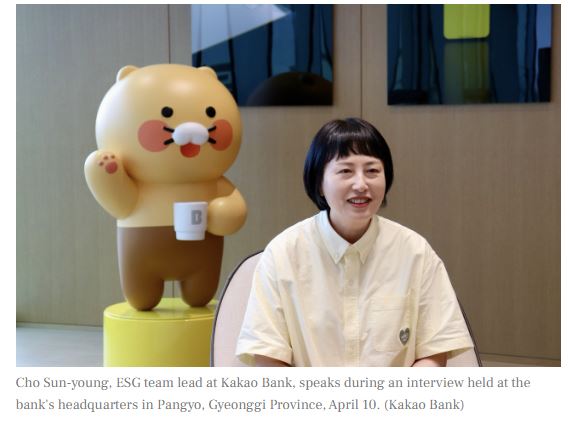
As sustainability shifts from a reputational issue to a business variable, Kakao Bank is treating ESG less as corporate messaging and more as a question of how finance itself is structured — from its mobile-only model to plans around financed emissions, green finance and environmental risk management.
For Cho Sun-young, ESG team lead at Kakao Bank, the goal is not simply to reduce the company's own footprint, but to connect environmental value with the bank's operating model, customer experience and long-term competitiveness.
"For Kakao Bank, the circular economy goes beyond simply reducing costs. It is our business model itself and an important strategy for sustainable growth," Cho said in a recent interview with The Korea Herald.
The interview was conducted ahead of "H.eco Tech Festa 2026," which will be held May 7 at Yonsei University in Seoul, where Cho is set to join a panel discussion. Hosted by Herald Corp., the event will bring together industry leaders to explore how sustainability-driven initiatives can translate into growth opportunities.
At Kakao Bank, sustainability begins with its digital architecture. As a mobile-only lender with no paper passbooks or physical branches, the bank says resource efficiency is built into its business model.
That is also reflected in its operations. In 2024, KakaoBank ran about 4,700 virtual servers, cutting electricity use by around 3.83 million kilowatt-hours. Virtual servers can use about one-fourteenth as much electricity as physical servers through more efficient infrastructure management.
"This reduced carbon emissions by roughly 1,700 tons — the equivalent of planting about 270,000 pine trees," Cho said.
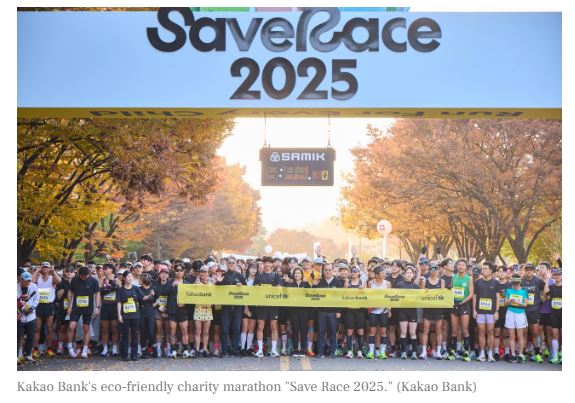
Cho said the more meaningful shift is taking place across the industry, as ESG moves beyond branding and becomes a matter of financial resilience. "Non-financial values such as environment, society and governance are no longer invisible values," she said. "Managing environmental risks is directly tied to improving management stability, and in the long run, that contributes to raising a company's financial value."
That broader view is why Kakao Bank is looking beyond its own footprint toward what Cho called "the flow of finance" itself. "Recently, our team has been interested in connecting the environment directly with financial performance, not only through internal efforts such as data center efficiency, but by changing the flow of money itself in a greener direction," she said.
That next phase centers on financed emissions, portfolio management and preparations for green finance and transition finance. "We want to shift our portfolio, including lending and investment, in a lower-carbon direction through financed emissions management," Cho said. "It is like engraving the value of 'environment' into the bank's financial statements."
Much of that work remains in the early stages, but the bank is beginning to lay the groundwork.
"We are planning to introduce ESRM, or environmental and social risk management, starting this year," Cho said. "If introduced, we expect to use it as a basis for future policy-making and decision-making."
Cho said the real test of environmental finance will ultimately depend on measurable outcomes. "The biggest trap of greenwashing is setting KPIs around activity rather than outcome," she said. "The single most important KPI, if I had to choose one, is the reduction of financed emissions."
jwc@heraldcorp.com
https://www.koreaherald.com/article/10723227





 이전글
이전글