
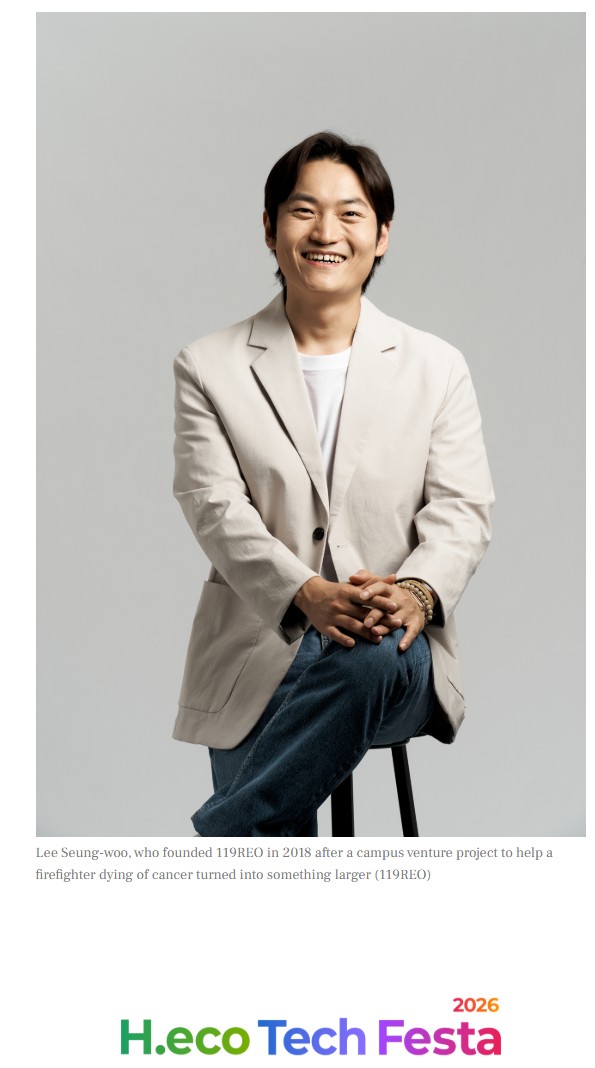
Lee Seung-woo's company started with a missed fundraising goal that turned into something else entirely.
In 2016 as a student at Konkuk University in Seoul, Lee joined a one-year campus venture project to raise money for a firefighter dying of a rare cancer. The team collected discarded turnout coats — the heavy aramid-fiber jackets Korean firefighters wear into burning buildings — and stitched them into bags and key rings. After 12 months, they had a small donation ready for the family.
The family refused it.
"They told us this was not their son's problem alone, but a problem belonging to all firefighters, and that the money should go to others in worse situations," Lee recalled in an interview with The Korea Herald ahead of H.eco Tech Festa 2026, the Herald Media Group business forum set for May 7 at Yonsei University in Seoul.
That refusal is the moment Lee identifies as the founding of 119REO, the social venture he incorporated in 2018. The name combines Korea's emergency number with "Rescue Each Other." Half of operating profit goes to firefighters battling cancer, post-traumatic stress disorder or amputation injuries, with cumulative donations reaching roughly 200 million won ($135,000).
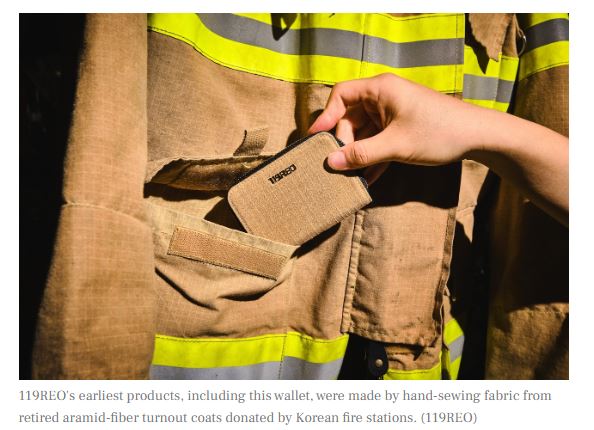
The harder business question came later. Out of every 100 turnout coats donated by fire stations, Lee said, only 20 to 30 are typically suitable for upcycling. The majority of the donations were therefore stored in shipping containers behind the workshop. By 2022, two were already full.
So 119REO built a recycling line. In November 2024, it opened a plant in Ansan, Gyeonggi Province, producing about 20 metric tons a year of recycled aramid short fiber. Lee said the recycled version costs 40 percent less than virgin aramid while retaining 90 to 95 percent of its performance.
What the fiber would be used for turned out to be the harder problem.
"Just because we'd closed the loop didn't mean anyone wanted to buy it," Lee said. Fashion could not absorb the price. And established aramid suppliers had locked-in customers.
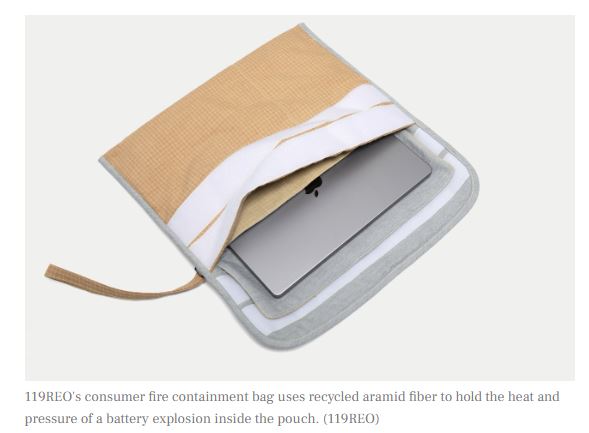
The opening came from an unrelated direction. In January 2025, a power bank exploded inside an Air Busan jet at Gimhae International Airport before takeoff, igniting a cabin fire. All passengers escaped practically without incident, but Busan's fire authority went looking for a containment product after off-the-shelf Chinese pouches failed in their tests.
With that impetus, 119REO developed a fire containment bag using the recycled aramid, priced around 70,000 won against roughly 1.2 million won for a comparable US-made product. A separate aircraft-grade version is now supplied to Korean Air and eight other Korean carriers.
"Resource circulation isn't just an environmental story when it meets the right technology, it can produce a better product," Lee said. He called the current model "Level 3," with a "Level 5" version designed to extinguish a fire rather than only contain it targeted by the end of 2027.
Revenue reached 600 million won in 2024 and 715 million won in 2025 — slow numbers next to most startups. Lee pushed back on the framing.
"Some might say the donations held us back. I'd say we are growing solidly," he said. "What 119REO has to protect is not the growth rate, but the trust we built with customers."
Lee will speak at the H.eco Tech Festa's first session, "Sustainable Ideas Going Global," on May 7.
mjh@heraldcorp.com
https://www.koreaherald.com/article/10728511





 이전글
이전글