
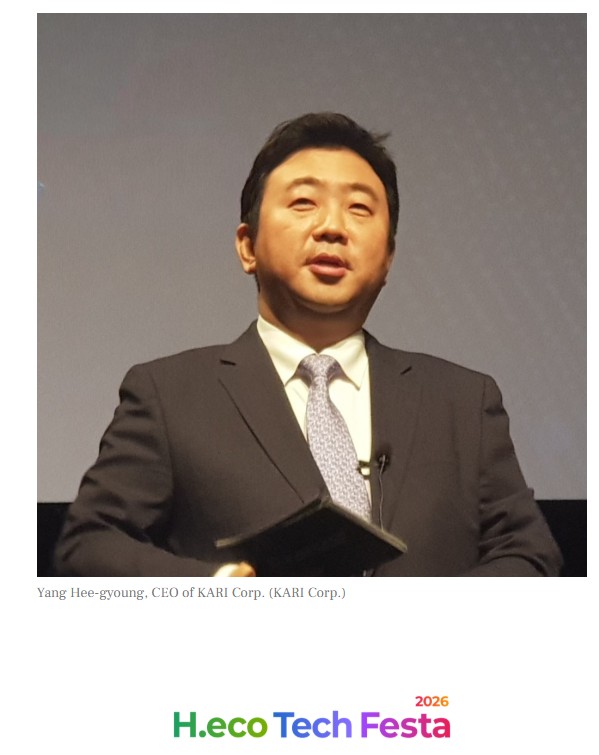
When much of the world still treats environmental compliance as a cost center, Yang Hee-gyoung, CEO of KARI Corp., a specialist in resource recovery from high-salinity wastewater, is making a more pragmatic case that pollution can pay.
Speaking ahead of H.EcoTech Festa 2026, a forum on climate solutions and economic opportunity, Yang said converting environmental value into economic gain is now “a very realistic conversation.” In his view, that shift is most evident in industrial wastewater, long seen as something to be discarded.
“KARI recovers valuable materials such as lithium and nickel found in high-salinity wastewater, and refines byproducts like sodium sulfate into high-purity inputs for other sectors,” Yang said in an interview with The Korea Herald. Other applications include salt recycling and the reuse of industrial water.
“The idea began with a simple question as to why so many resources are still left in what we discard,” Yang noted.
The trend is particularly pronounced in battery manufacturing, where precursor production for cathode materials uses large amounts of water and chemicals, generating significant amounts of high-salinity wastewater.
While only a small share of waste streams is currently recycled into usable resources, battery makers are rethinking their approach to the problem, increasingly turning to outside specialists.
“The share of outsourcing is increasing,” Yang said, citing high technical barriers and costs. “More companies see it as more economical to work with specialized firms.”
That is where KARI's patented technology comes in, using crystallization-based processes to recover valuable metals from industrial effluent.
The result, which Yang describes as a “cross-industry value chain,” supplies materials such as high-purity sodium sulfate to pharmaceutical and cosmetic manufacturers. The process operates at less than half the cost of conventional methods, with advantages in stability and scalability, Yang added.
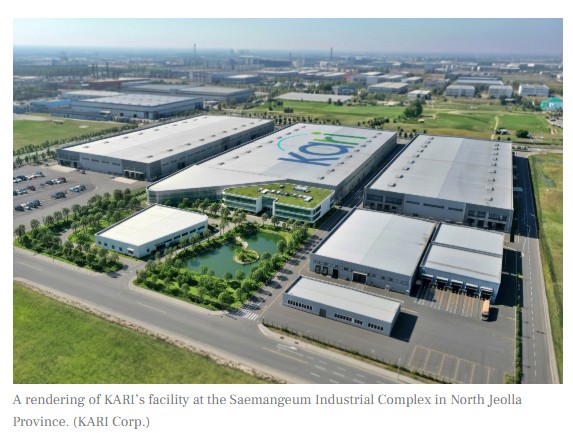
As it scales up, the company plans to complete a facility in the Saemangeum Industrial Complex in the first half of 2027 to process battery wastewater and recycle recovered materials.
It is also preparing to expand into the US and Europe from 2027. “The US and Europe tend to see the environment as a source of industrial competitiveness rather than regulation,” Yang remarked. “They evaluate both economic feasibility and environmental, social and governance value, while Korea still tends to approach it from a regulatory standpoint.”
That thinking also shapes his advice to younger professionals entering the field. “You need to understand the structure of industries and connect technology to economics,” he said. The climate challenge is no longer something that can be deferred. “I hope we can tackle this together with a sense of responsibility and mission.”
Yang will speak at H.EcoTech Festa 2026 on May 7 at Yonsei University, focusing on turning sustainable ideas into global opportunities.
minmin@heraldcorp.com
https://www.koreaherald.com/article/10728144





 이전글
이전글