

Sustainability is increasingly shaping how companies compete — not as a cost, but as a condition for market access and long-term competitiveness.
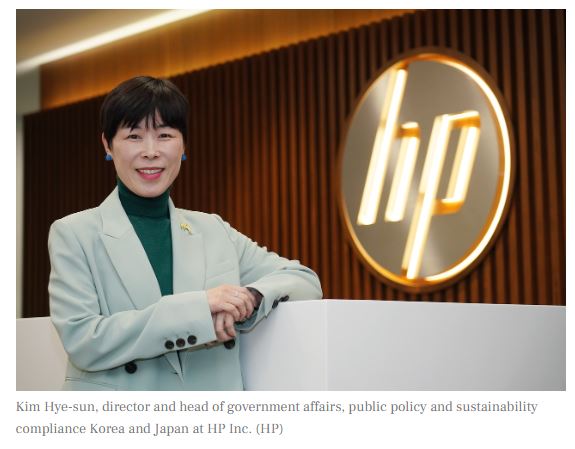
The shift is already reflected in business performance, with more than 60 percent of HP’s global revenue tied to products and services that contribute to reducing environmental impact, Kim Hye-sun, head of government affairs, public policy and sustainability compliance for Korea and Japan at HP Inc., said in a recent interview with The Korea Herald.
“What used to be seen as a value or commitment is increasingly becoming a requirement in transactions,” she said, noting that customers and partners now weigh sustainability alongside price and performance.
Kim is set to speak at the “H.eco Tech Festa 2026” on May 7 at Yonsei University’s Baekyangnuri Hall. The event will bring together industry leaders to discuss how sustainability-driven innovation is translating into global market opportunities.
At HP, that shift is visible in how products are designed and delivered. The company has built circular systems to recover and reuse materials such as cartridges and plastics, embedding resource efficiency into product development from the outset.
The approach has also expanded beyond the company itself. Through its Amplify Impact program, HP encourages partners to integrate sustainability into their business strategies — a move that has begun to translate into measurable commercial outcomes.
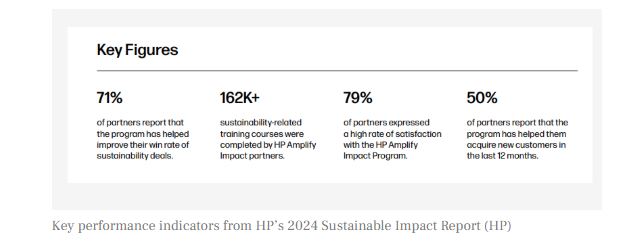
The impact is not just structural, but commercial. More than 70 percent of participating partners reported improved win rates in sustainability-related deals, while about half said they had gained new customers through the program, according to HP’s 2024 Sustainable Impact Report.
“Once customers begin to see sustainability as part of their decision-making framework, it directly affects deal structures and win rates,” Kim said.
Kim said the benefits of sustainability investments may not always be immediate, but they are increasingly shaping long-term business conditions.
“If companies delay investment today, the cost returns later in the form of stricter regulation, supply chain instability and higher operational expenses,” she said.
Drawing on her experience leading sustainability policy advocacy across HP’s Asia-Pacific region until 2024, she noted that tensions between policy and profitability are often overstated.
“In many cases, the issue is not the direction of policy but how quickly and how consistently it is applied,” she said, pointing to the gap between globally integrated operations and locally designed regulations.
Kim also emphasized that sustainability efforts must go beyond visible outcomes or one-off initiatives, particularly in areas such as environmental impact and digital access, where change tends to be gradual.
“What matters is not just what we do, but who benefits and how,” she said, stressing the importance of aligning corporate responsibility with real-world impact.
She pointed to circular economy solutions, energy efficiency and data-driven environmental technologies as areas where sustainability is likely to generate the most value.
“Sustainability is no longer a discretionary effort,” she said. “It has become a baseline expectation that underpins corporate credibility and long-term resilience.”
yeeun@heraldcorp.com
https://www.koreaherald.com/article/10719098