
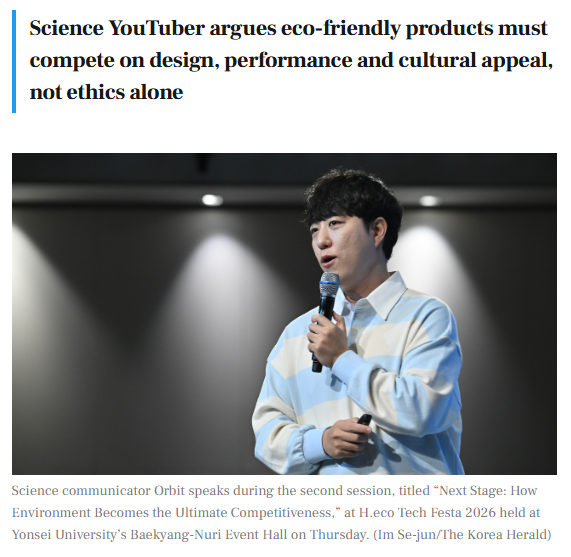
Environmental campaigns driven by guilt and statistics alone are unlikely to change human behavior, science communicator Orbit said Thursday, arguing that sustainability must become attractive and culturally appealing to succeed in the marketplace.
Speaking at H.eco Tech Festa 2026 at Yonsei University’s Baekyang-Nuri Event Hall, Orbit, who runs a science YouTube channel with more than 1.8 million subscribers, said climate action must be woven into everyday consumer choices.
“From a neuroscience perspective, simply appealing to people with environmental statistics or emotional pressure is not very effective,” Orbit said during his keynote speech. “Eco-friendly businesses need to become attractive in daily life and within the capitalist market.”
Orbit cited climate data showing that the number of cities capable of hosting the Winter Olympics is projected to fall from 93 today to 52 by 2050. He also noted that artificial snow use rose from 80 percent at the 2014 Sochi Winter Olympics to 100 percent at the 2022 Beijing Winter Olympics.
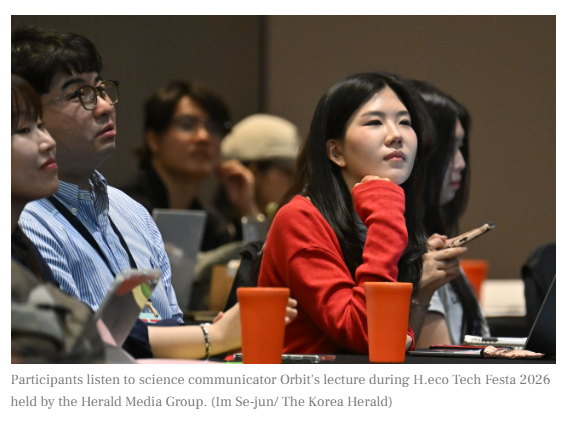
He also referenced studies suggesting climate change is reducing annual sleep time by about 44 hours due to rising nighttime temperatures, while altering ecosystems and animal behavior worldwide.
Yet despite presenting alarming data, Orbit argued that people often fail to maintain long-term concern about climate issues because of how the human brain processes future risks.
“You may feel the seriousness of environmental problems for a moment, but people quickly return to their usual routines,” he said. “That’s not because people are irresponsible; it’s because of how our brains work.”
He explained the concept of “temporal discounting,” in which people perceive future benefits and risks as less important than immediate ones. According to Orbit, neuroscientific research suggests the brain activates similar regions when thinking about one’s future self and about strangers.
“Climate change is fundamentally viewed by the brain as a future problem,” he said. “And future problems feel psychologically distant.”
Instead of relying on warnings alone, Orbit said successful climate businesses and policies must make sustainability feel aspirational, desirable and culturally relevant.
He pointed to Tesla as a major example.
“People do not buy Teslas simply because they are environmentally friendly,” Orbit said. “They buy them because the design is attractive and the performance is impressive.”
According to Orbit, Tesla succeeded not by preaching environmental ethics but by making electric vehicles feel stylish and technologically advanced.
“That is what made electric vehicles desirable,” he said. “The result happened to be environmentally friendly.”
Orbit cited research published in The Lancet suggesting that every additional 200 EVs on the road could reduce annual nitrogen dioxide emissions by 1.1 percent. While acknowledging that fossil fuels are still used in electricity generation, he said EVs remain meaningful because they reduce greenhouse gas emissions during operation.
He also argued that branding plays a major role in changing environmental behavior, saying eco-friendly lifestyles and upcycled products need to be perceived as “hip” rather than burdensome.
“If people start thinking that using upcycled products is cool and stylish, that is when real change begins,” Orbit said.
He praised H.ecoTech Festa itself for attempting to make sustainability feel more culturally engaging through performances, interactive sessions and business-oriented discussions.
“Environmental events should not feel rigid or obligatory,” he said. “They need to feel exciting and attractive.”
Orbit concluded the lecture by quoting American environmentalist David Brower: “There is no business to be done on a dead planet.”
“But at the same time,” Orbit added, “environmental businesses must still understand efficiency, branding and market appeal. That is how sustainable change becomes scalable.”
jychoi@heraldcorp.com
https://www.koreaherald.com/article/10734581