
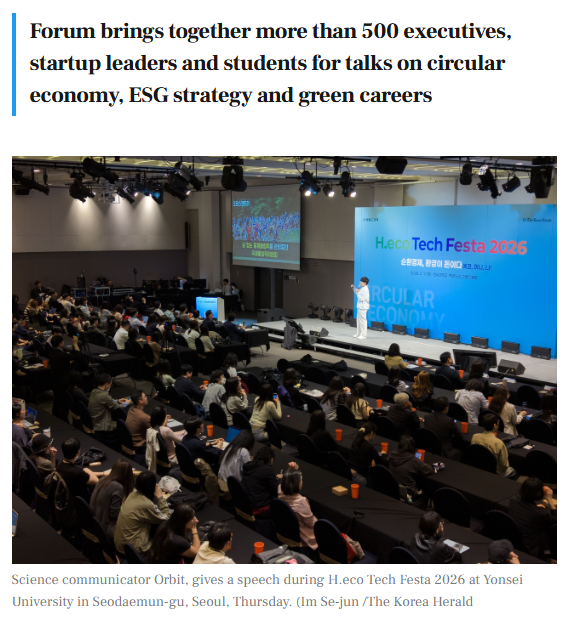
Environmental challenges are no longer treated simply as matters of corporate responsibility, but as markets in their own right, creating new opportunities for companies, investors and young professionals, speakers said Thursday at H.ecoTech Festa 2026 in Seoul.
Hosted by Herald Media Group at Yonsei University’s Baekyang-Nuri Event Hall, the forum brought together entrepreneurs, corporate executives, sustainability experts and students to discuss how climate solutions and circular-economy industries are reshaping global markets.
Held under the theme “Circular Economy: Environment Is Money, Eco, Money, Me,” the event drew some 500 participants and featured discussions on climate-tech startups and future career opportunities in sustainability-related sectors.
In his opening remarks, Choi Jin-young, publisher and CEO of Herald Media Group, said responding to the climate crisis has become “a key engine for creating new economic value.”
“The environment is now one of the fastest-growing markets, one of the most powerful technologies and the starting point of new wealth creation,” Choi said.
Kim Yong-ho, executive vice president for administration and development at Yonsei University, said environmental value is increasingly becoming central to economic growth and career development.
“Our task is to help younger generations transform environmental values into real career assets,” Kim said.
The event opened with a performance by Raf Sandou, a Yonsei University alumnus known for appearing on the rap competition show “Show Me the Money 12.”
Holding a reusable cup on stage, Raf Sandou encouraged participants to think about how clothing is produced, consumed and discarded, saying sustainable consumption itself can become part of culture and style.
Science communicator Orbit later delivered a special lecture arguing that environmental businesses must become attractive and culturally appealing in order to drive meaningful behavioral change.
“People do not buy products simply because they are environmentally friendly,” Orbit said. “Successful eco-friendly businesses must become attractive products themselves.”
Citing Tesla as an example, Orbit said the electric vehicle-maker succeeded not by promoting sacrifice or environmental guilt, but by making sustainability feel technologically advanced and desirable.
The forum’s first session focused on circular-economy businesses transforming waste materials into commercially viable products and services.
Lee Chung-ho, CEO of ReFeed, introduced a business model that converts used cooking oil into supply-chain resources for sustainable aviation fuel, while Lee Seung-woo, CEO of 119REO, showcased technology that recycles discarded firefighter uniforms into fire containment devices used by domestic airlines.
Yang Hee-gyoung, CEO of KARI Corp., discussed resource-recovery technologies for industrial wastewater generated during secondary-battery manufacturing. Kim Hye-sun, head of government affairs, public policy and sustainability compliance for Korea and Japan at HP Inc., explained how sustainable product lines account for more than 60 percent of HP’s annual revenue.
Moderating the session, Lee Han-kyung, CEO of Eco&Partners, said the circular economy is creating industries in which “one person’s waste becomes another person’s valuable resource.”
The second session examined how sustainability expertise is becoming an increasingly important source of competitiveness across industries, from finance and manufacturing to law and consulting.
Cho Sun-young, ESG team lead at Kakao Bank, said environmental initiatives are increasingly tied to customer trust and brand loyalty in the financial sector.
Jeong Soo-jeong, head of LG Electronics' ESG Strategy Planning Team, discussed how sustainability has become an important factor in global business competitiveness and investment decisions.
Yoon Yong-hee, a partner at law firm Yulchon, discussed how environmental regulations and ESG-related legal risks are reshaping corporate strategy, while Kim Kyeong-yeon, head of global strategy at Eco&Partners, emphasized the importance of cross-sector cooperation in climate projects.
The event concluded with a career mentoring program in which professionals from major companies met with students and young participants in small-group sessions to discuss practical career paths and opportunities in the growing eco-tech sector.
Organizers said the forum would serve as a networking platform connecting future talent with innovators and industry leaders working at the intersection of climate technology, business and sustainability.
jychoi@heraldcorp.com
https://www.koreaherald.com/article/10734583